Parts of a staircase: a labeled guide to every stair part
A staircase combines structural parts that carry the steps with finish and safety parts you see and touch. The labeled diagram and glossary explain each term in plain language.
Labeled staircase diagram
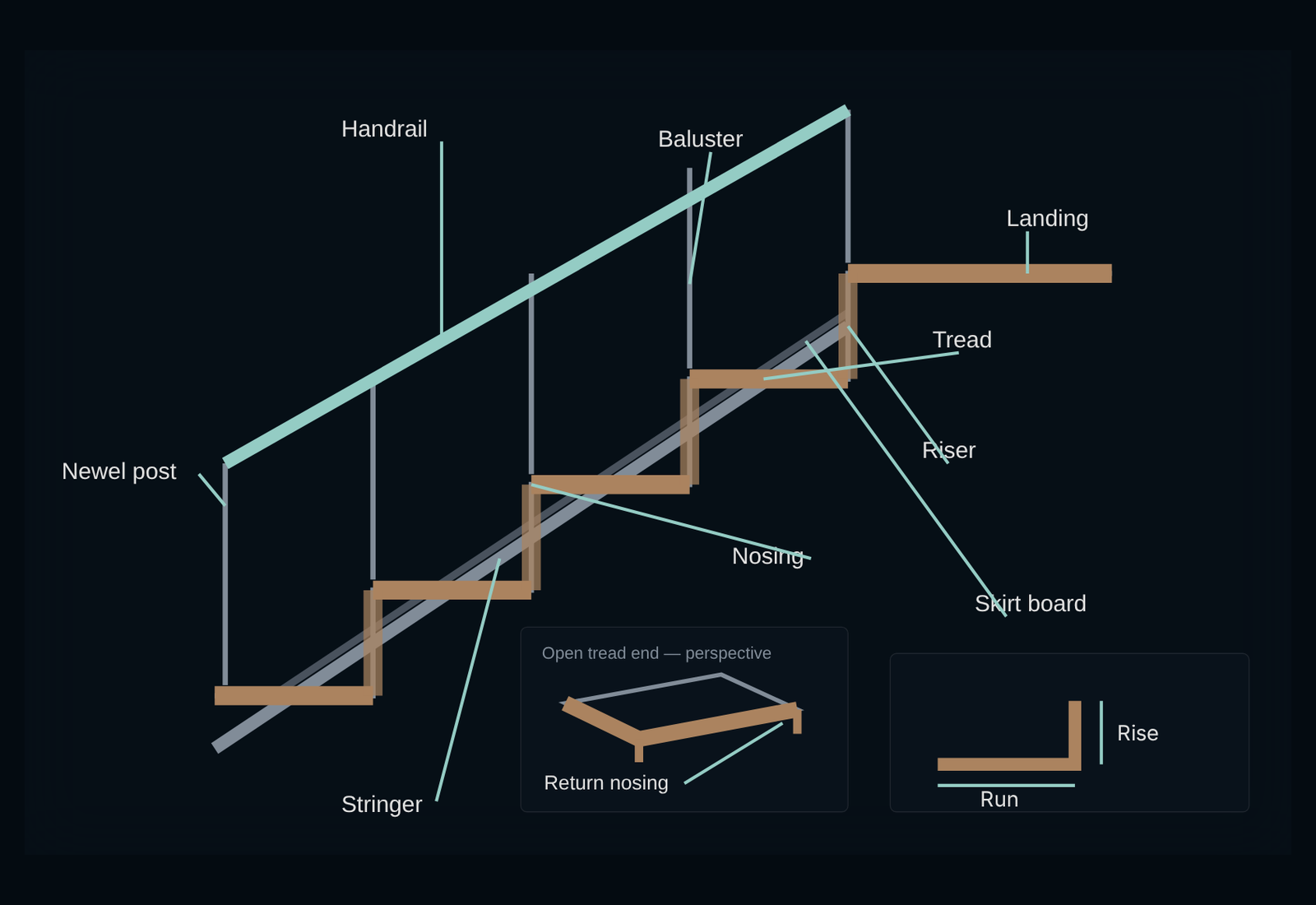
The accessible diagram labels the tread, riser, nosing, stringer, landing, return nosing, skirt board, handrail, baluster, newel post, rise and run. Tinted parts are the parts that show the flooring.
The steps: tread, riser and nosing
- Tread — the horizontal surface you step on.
- Riser — the vertical board between one tread and the next; open-riser stairs leave this space empty.
- Nosing — the finished front edge of the tread where it meets or projects beyond the riser.
- Rise and run — rise is the vertical step-to-step height; run is the horizontal depth measured nosing to nosing. Check local building code before changing a stair.
Stair treads and risers explained
The structure: stringers and landings
- Stringer — a sloped structural member supporting the steps. It may be cut/open or closed/housed.
- Landing — a flat platform at the top, bottom or turn of a stair. The landing edge may also need nosing.
The edges: open sides, returns and skirt boards
- Open side — a stair end not against a wall.
- Return nosing — the finished piece carrying the front-edge profile around an exposed tread end.
- Skirt board — trim running along the wall side of a stair and covering the tread-and-riser joint at the wall.
The railing system
- Handrail — the rail held while climbing.
- Baluster — a vertical post filling the space below a handrail on an open side.
- Newel post — the larger post anchoring the handrail at the ends or turns. Check local code for safety dimensions and spacing.
Special steps and terms
- Bullnose can mean a rounded nosing profile or a wider starter step with a rounded end; Tread Space does not claim to make starter steps.
- Floating stair — an open-riser stair where the treads appear to float on a wall, central stringer or other structure.
Which stair parts show your flooring?
- Treads, risers, nosings, landing edges and return nosings are the finish parts that can carry the flooring. Tread Space makes approved finish parts from flooring identified for each project; it does not make stringers, balusters, newels, handrails or skirt boards.
- Handmade in Columbia Falls, Montana. Every nosing, tread and riser is made by hand and custom-fit to your flooring and your stairs. LVP and wood flooring are wrapped in-shop into stair parts made by hand, so the stairs read as part of the floor rather than an added trim. Send your box-label details and stair measurements for a written quote.
Common questions
What are the main parts of a staircase?
The main parts are treads, risers, nosings, stringers, landings and the railing system: handrail, balusters and newel posts.
What is the difference between a tread and a riser?
The tread is the horizontal part you step on. The riser is the vertical part between one tread and the next.
What is the nosing on a stair?
The nosing is the finished front edge of the tread. On a stair covered with plank flooring, it is often a separate part finishing that edge.
What is the difference between rise and run?
Rise is the vertical step-to-step height. Run is the horizontal depth measured from one nosing to the next. Check local building code for required dimensions.
What is a return on a staircase?
A return nosing finishes the exposed end of a tread on an open side, carrying the front-edge profile around the corner.