Stair Parts for Laminate: Treads, Nosing and Risers That Match
The problem with laminate stairs is almost never the laminate. It’s the trim. You run a good floor through the house, then hit the stairs and find a stock nosing that is close in color but wrong in sheen, wrong in grain and wrong in edge. Everyone sees it from the front door.
The fix is to stop shopping for a near match. We build treads, nosing, risers and returns from your own laminate, so the stair parts come from the same flooring as the room next to them. You send the flooring details and the stair requirements, and we quote the job.
TL;DR
- Laminate stairs need three parts that work together: a tread with a nosing edge, a riser, and a return where a stair is open on the side.
- Stock nosing is made to a catalog color. Parts made from your own flooring match the floor because they are the floor.
- Check riser height, tread depth and nosing projection against your local code before you order anything.
- Send us the flooring, the stair type and your counts. We review the job for fit and quote it.
- Installation guides come with the work, so a crew can set parts without guessing.
Table of Contents
- What each laminate stair part does
- Why stock laminate stair parts miss the match
- What to check before you order
- What to send us for a laminate stair quote
- Laminate, LVP and hardwood: same idea, different material
- Residential, commercial and multifamily jobs
- Installing laminate stair parts
- Our view on laminate stairs
- Get laminate stair parts made from your floor
- FAQ
- Sources
What each laminate stair part does
Let’s name the parts, because people mix them up on quotes.
The Floor Covering Reference Manual, a professional flooring reference, describes laminate stair treads as wrapped MDF or HDF pieces with a bullnose nosing, sized to the full tread depth and width. It describes risers as matching pieces sized to the full tread width and riser height, with the top usually covered by the bullnose of the tread above. Nosing is sometimes a separate extruded aluminum piece set flush with the tread, or an overlapping piece fastened to the substrate on wider treads. The same manual notes that overlapping nosings should be verified against code.
In plain terms:
- Tread: the part you step on. On a laminate stair it carries the rounded front edge.
- Stair nosing: the front edge of the step. It can be part of a one-piece tread or a separate strip that finishes the edge of a floor board cut to the step.
- Riser: the vertical face between treads.
- Return nosing: the finished end piece where a step is exposed on the side, such as an open stair along a wall or a half wall.
- Wall-to-wall treads: full-width treads for stairs that run between two walls.
We make all of these. You can see the range on our stair parts made from your flooring page, and the laminate-specific side on our page about laminate stair nosing from your flooring.
Why stock laminate stair parts miss the match
Laminate is a printed surface. The decor layer, the embossing and the sheen all change from one product line to the next. A molding maker has to cover dozens of floors with a handful of nosing profiles, so the match is approximate by design.
That shows up three ways on a job:
- Color drift. The nosing looks right in the box and wrong on the stair, under real light.
- Pattern break. The plank pattern stops at the edge and a different pattern starts. On a wide stair this is the first thing you see.
- Profile mismatch. The nosing sits higher, lower or rounder than the floor next to it, so the edge reads as an add-on.
A stair is a vertical, high-visibility surface. A small mismatch on a living room floor is easy to ignore. The same mismatch repeated 13 or 14 times in a row is not.
Making the parts from your own flooring removes the guesswork. The parts carry your decor, your sheen and your edge. We work from your laminate, so the stair reads as part of the floor rather than a trim package.
What to check before you order
Get the geometry right first. Parts that match perfectly still fail inspection if the stair is out of tolerance.
Riser height and the first step
Code limits how much risers can differ in a flight. In the IRC section on stair treads and risers, the tallest riser may not exceed the shortest by more than 3/8 inch. That text is one city’s adopted version of the model code, so read your own jurisdiction’s edition.
Here is where laminate jobs go wrong. A tread and riser kit adds thickness at every step. Flooring at the top and bottom of the flight adds its own thickness too. If the floor at the foot of the stairs doesn’t rise by the same amount as the stair covering, the bottom riser ends up taller or shorter than the rest. Measure the finished heights, not the bare framing, and plan the landing floor and the first step together.
Tread depth and nosing projection
The same code section says a nosing of at least 3/4 inch and no more than 1-1/4 inches is required on stairways with solid risers, and the radius of curvature at the nosing can’t exceed 9/16 inch. Many codes drop the nosing requirement when the tread is deep enough, so check the edition your building department uses.
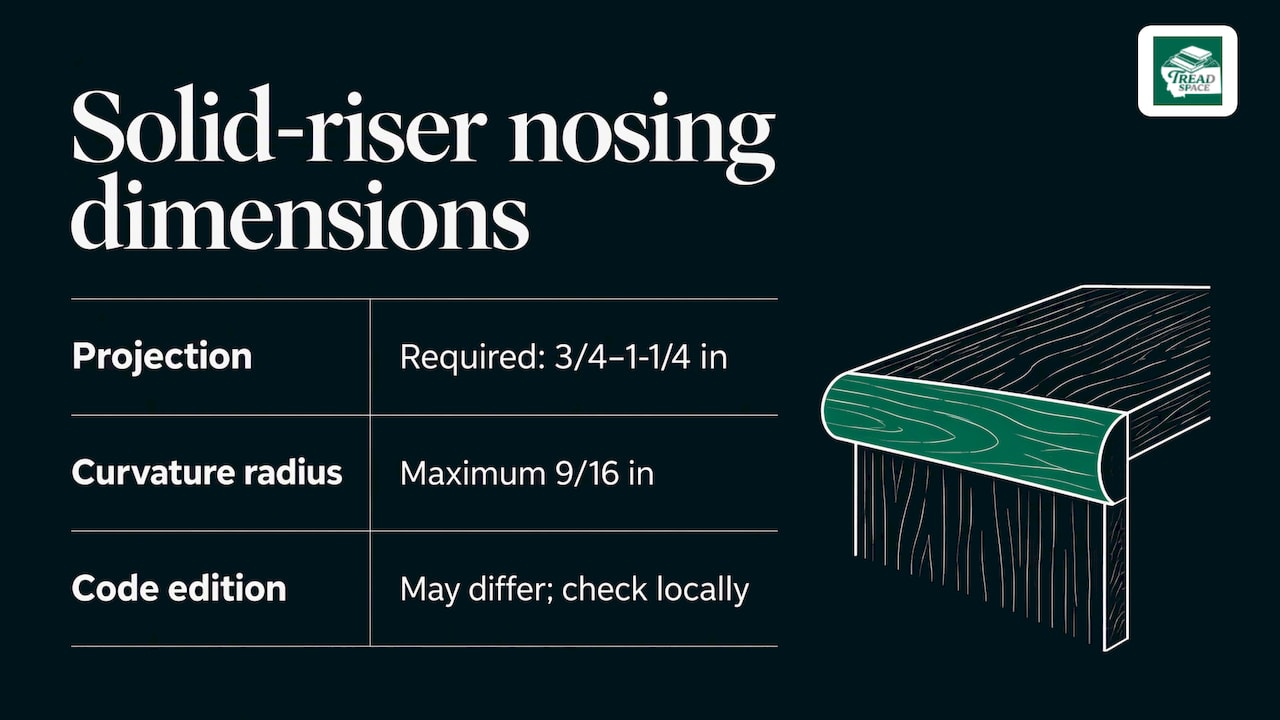
We publish the common numbers on our page for standard stair tread dimensions and code minimums. Use it as a starting point, then confirm with your inspector.
Codes also differ by country. Australian stair builders, for example, work to their own building code nosing requirements, so numbers from one country shouldn’t be carried over to another.
Open or closed sides
Count which steps are exposed on one or both sides. Each open end needs a return. Mark them on your sketch, with left or right as seen from the bottom of the stairs. Our guide to stair return nosing for open-sided stairs shows how those pieces finish the edge.
Edge style
Decide between bullnose and square edge, and between a flush or overlapping nosing. The edge changes the look and the way the part sits on the stair. Our pages on bullnose versus square edge treads and stair nose types lay out the choices.
What to send us for a laminate stair quote
A good quote starts with a clear brief. Send us this:
- The flooring: brand, line and color if you have it, plus the material type, which here is laminate. Your remaining boxes or a spare plank help if the floor is already down.
- Number of steps: and whether each is the same size.
- Tread width and depth: measured on each step. Stairs are rarely identical, so measure them all, not just the first and last.
- Riser height: measured to the finished surface.
- Stair type: closed, open on one side, open on both sides, wall-to-wall, or floating.
- Edge preference: bullnose, square, flush or overlap.
- Lighting plans: if you want under-tread lighting, tell us up front. We offer options for under-tread lighting preparation.
- Photos: the whole flight, plus close-ups of the top and bottom steps.
We review each job for fit and project needs, and our quote process is quick. You can start through our custom stair treads page or call us.
If you’re not sure whether your stairs suit a covering or a full tread, our page on stair parts by flooring type compares laminate, LVP and wood.
Laminate, LVP and hardwood: same idea, different material
The job is the same on every floor: finish the step so it matches the room. The material changes how the part is made.
Laminate has a hard, printed face on a fiberboard core. LVP is a vinyl plank. Hardwood is solid or engineered wood. Each reacts differently to cutting, shaping and finishing, which is one more reason stock trim for one product rarely suits another.
We make stair parts from all three. If your project is vinyl, see our LVP stair parts and LVP stair nose pages. For wood, see hardwood stair treads from your flooring. On a mixed job, such as laminate on the main flight and wood in the basement, you can order both from one place.
Residential, commercial and multifamily jobs
The parts are the same, but the paperwork is not.
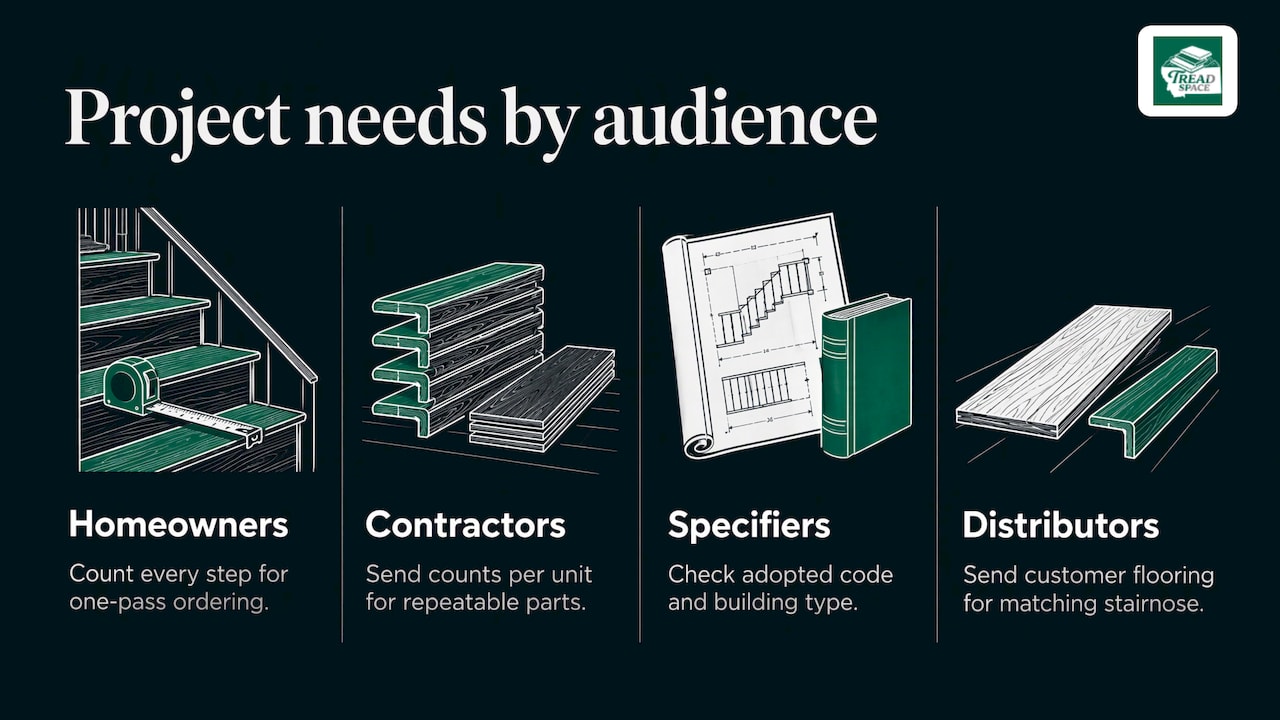
Homeowners and remodelers care most about the look and the schedule. Order once, with every step counted, so the stair gets done in one pass.
Builders and flooring contractors care about repeatability. When a crew runs the same floor through a dozen units, they need parts that match from unit to unit, with consistent dimensions. Send the counts per unit and we quote the whole project.
Architects and specifiers should confirm nosing, tread depth and riser limits against the code edition adopted for the project, and note whether the building is residential or commercial, since commercial stairs are often held to different limits. Put the flooring on the spec and let the stair parts follow it.
Flooring stores and distributors can send us the floor their customer bought and get matching stairnose made from it, instead of telling the customer to hunt for a close color.
We ship nationwide from our team in Montana.
Installing laminate stair parts
A matched part still needs a clean install. The general sequence is:
- Prep the stair. Remove old covering, tacking and adhesive. Check that each step is solid, clean and flat.
- Dry-fit every part. Set each tread and riser without adhesive and look at the gaps at the walls and stringers.
- Check riser heights. Confirm the finished risers stay within code before you glue anything.
- Fasten from the bottom up or as the guide directs. Parts bond to the stair with the adhesive and fasteners suited to the substrate.
- Finish the edges. Set returns at open sides and fill or trim as needed.
Our installation guide for stair treads and nosing walks through the steps in detail, and it’s built so a crew can follow it on site. Because we review each job for fit before it ships, the dry-fit step is a confirmation, not a surprise.
Our view on laminate stairs
Most of the stair calls we get start the same way. The floor is in, it looks good, and then the stair trim arrives and it’s off.
Our answer is simple. Don’t hunt for a match. Make the parts from the floor you already have. We hand-make treads, nosing, risers and returns in Montana from your laminate, LVP or wood, and we review each job for fit before it goes out.
A stair is the one place in the house where every step is seen at eye level and touched by every person who walks up. That’s why we think the parts should come from the same material as the floor, built to your sizes, and not pulled from a bin of near matches.
We send installation guides with the work because a good part set badly still looks bad. Builders, installers and homeowners can all use them.
Tread Space Team
Get laminate stair parts made from your floor
If you have a laminate floor and a stair that needs to match it, we make the treads, nosing, risers and returns from that floor. We also build floating treads, wall-to-wall treads and parts with under-tread lighting preparation.

See the full range on our custom stair treads page, browse finished work in the stair tread and nosing gallery, or send us your project details for a written quote.
FAQ
Can I get stair nosing that matches my laminate exactly?
Yes. We make nosing from your own laminate, so the color, pattern and sheen come from the same flooring. Send us the floor details and the stair requirements and we’ll quote it.
What parts do I need for a laminate stair?
Most stairs need treads with a nosing edge and matching risers. Stairs with an open side also need return nosings. Wall-to-wall stairs and floating stairs use their own tread styles. Count each type per step before you request a quote.
Do I need to worry about code when I cover stairs with laminate?
Yes. Riser height, tread depth and nosing projection all have limits, and the covering changes the finished dimensions. In the model code text we cite, risers in one flight can differ by no more than 3/8 inch. Check the edition your local building department uses before you order.
Can the same order include stair parts for other floor types?
Yes. We make stair parts from laminate, LVP and real wood. If a project has more than one floor type, send the details for each and we’ll quote them together.
Do you ship outside Montana?
Yes. Our team is based in Montana and we ship stair parts nationwide.
Sources
- E03C Flooring, Floor Covering Reference Manual
- IRC Chapter 3, Section R311.7.5 Stair treads and risers, as adopted in Rapid City
- Custom staircase builders, building code and nosing requirements
Ready to quote your stairs? Call us at 406-309-0616 or email sales@tread-space.com.